

Certified vs Uncertified: How CREATMAN's Professional Elevators Standards & Patents Protect Buyer Safety
In the modern landscape of vertical transportation and high-end residential architecture, the reliability of a building's transit system begins long before final installation. At the heart of every dependable lift lies the structural integrity of its internal hardware. For global distributors, architects, and property developers, choosing a reliable Professional Elevators Factory is paramount.
Complete residential and commercial elevator systems encompass a broad and critical array of mechanical and electronic assemblies-ranging from precision guide rails, door operators, and safety gears to sophisticated control cabinets and drive systems. These components must work in flawless harmony to support smooth daily movement, regulate speed under heavy loads, and prevent unexpected mechanical failure. When sourcing complete lift solutions, the distinction between certified and uncertified production standards often determines whether a transit system operates securely for decades or poses hidden risks from day one.
The Evolving Landscape of Vertical Mobility and Global Standards
The global demand for advanced villa elevators, residential platforms, and custom mobility solutions has expanded rapidly over recent years. Driven by urbanization, an aging population, and architectural innovations emphasizing multi-level residential spaces, modern buildings require vertical transit options that integrate seamlessly into complex architectural layouts. However, this growth brings heightened responsibility. Modern regulatory bodies across international markets enforce stricter compliance frameworks to safeguard building occupants, demanding rigorous adherence to engineering tolerances, material traceability, and electrical safety.
In international lift manufacturing, specific European Norms define compliance requirements based on the lift's intended application and drive architecture:
EN 81-41: Applies specifically to vertical lifting platforms intended for use by persons with impaired mobility, serving as the foundational safety benchmark for private residential villa lifts and home platforms.
EN 81-20: Defines safety rules for the construction and installation of passenger and goods-passenger elevators, establishing rigorous specifications for commercial and high-occupancy residential shafts.
Within this competitive market environment, industry trends favor manufacturers who invest heavily in research, development, and intellectual property. The integration of IoT monitoring, energy-efficient drives, and smart control systems means that elevator components are no longer passive mechanical pieces; they are active nodes within a smart building ecosystem. Consequently, global supply chains are shifting away from generic unverified manufacturing toward specialized engineering partners who can prove conformity through international testing protocols and proprietary technology. Staying competitive requires bridging the gap between aesthetic customization and rigid compliance, ensuring that every mechanical subsystem meets or exceeds globally recognized performance benchmarks.
Drive System Architectures and Regulatory Scope
When evaluating complete home lift safety, buyers must recognize that certification standards are strictly tethered to specific drive system architectures. Certification parameters cannot be interchanged or universally applied across different mechanical technologies:
Screw and Nut Drives: Engineered for low-rise residential spaces, requiring specific stress testing for thread wear, mechanical locking devices, and self-braking efficiency under EN 81-41.
Traction Drives: Utilize counterweight systems and steel ropes or belts, subject to stringent traction sheath friction, gear efficiency, and dynamic safety gear engagement parameters under EN 81-20/50.
Hydraulic Drives: Rely on fluid pressure mechanism compliance, requiring unique burst-valve testing, oil temperature regulation, and pressure relief valve certifications.
Attempting to apply a single certificate across distinct drive platforms creates severe compliance vulnerabilities. A certified traction lift system does not validate a screw-drive installation, making precise certificate verification essential.
Certified vs Uncertified: Standards, Patents, and Buyer Protection
The security of end-users relies heavily on the engineering discipline and regulatory compliance upheld by complete elevator manufacturers. At CREATMAN, safety is embedded into every layer of design through strict adherence to international quality frameworks and continuous technical innovation.
When a complete elevator system lacks proper certification, the consequences for building occupants and property owners can be severe. Uncertified safety gears, poorly machined guide rails, or inferior door locking mechanisms can lead to sudden car stalls, unlevel stopping, door entrapment, or severe mechanical failure during power fluctuations. Beyond physical safety hazards, uncertified lifts often result in frequent maintenance callbacks, costly emergency repairs, and legal liabilities for property managers and distributors.
The Four Essential Certificate Verification Elements
To ensure complete buyer protection, property developers and procurement managers must rigorously inspect manufacturer documentation. A valid, legally binding safety certificate must clearly display four core verification elements:
Official Certificate Number: A unique tracking identifier that allows direct verification within public regulatory databases.
Notified Body (NB) & Accreditation Number: Clear identification of the authorized European independent testing agency (and its official EU-registered NB number) that conducted the compliance audit.
Product Scope & Limitations: Explicit definitions stating the covered lift models, drive types, maximum load capacity, rated speeds, and allowed installation dimensions.
Validity Period & Audit Status: Active effective dates proving the certificate is currently valid and backed by routine factory production audits.
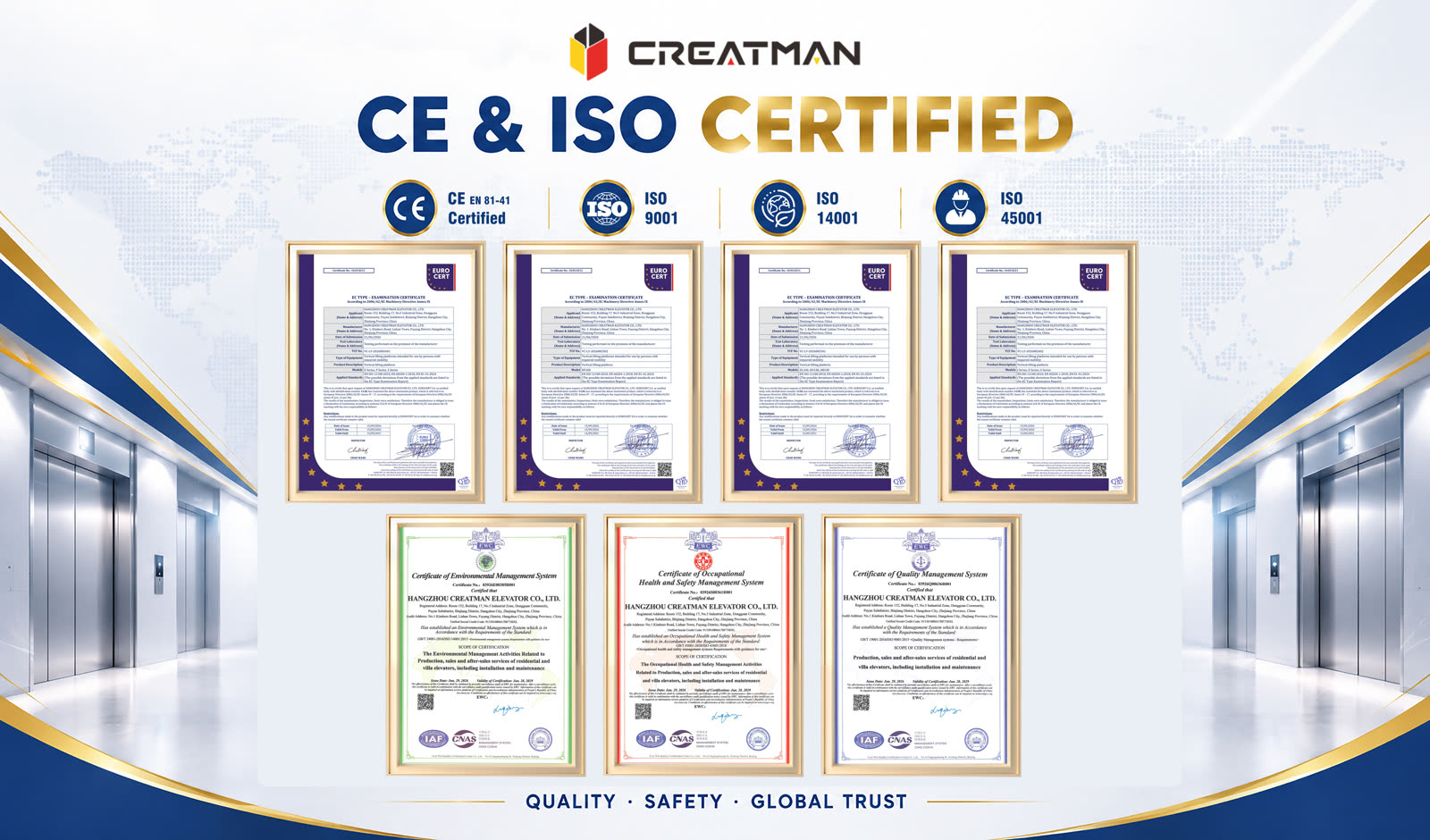
For detailed information regarding our official compliance credentials, please visit our Company Certificates page. These credentials provide buyers with absolute confidence that every CREATMAN complete elevator system will perform predictably under maximum load conditions, thereby protecting buyer safety and eliminating operational vulnerabilities.
Engineering Excellence, Core Competencies, and Application Scenarios
Beyond compliance, high-performance elevator manufacturing requires continuous technological innovation and precise craftsmanship. CREATMAN operates as a specialized service provider focusing on high-end custom villa elevator solutions, passenger and freight elevators, escalators, and comprehensive complete lift packages. By utilizing advanced manufacturing equipment and precision engineering principles, the enterprise integrates safety, intelligence, and quiet operation into every system.
CREATMAN's control systems exemplify modern engineering, offering stable signal processing, intelligent logic management, and compact spatial integration that suits luxury residential villas and commercial multi-story properties alike. These systems are designed to operate quietly and efficiently, blending seamlessly into sophisticated architectural aesthetics while maintaining rigorous industrial safety margins.
Our product applications span luxury private residences, loft and maisonette apartments, panoramic sightseeing shafts, and customized platform lifts. Each application environment presents unique spatial and mechanical challenges. By offering comprehensive OEM and ODM services, CREATMAN collaborates closely with global distributors to tailor elevator specifications--such as variable car dimensions, specialized drive configurations, and refined interior finishes-to exact project requirements without compromising structural safety.
Integrated Procurement and Technical Support Solutions
Sourcing reliable elevator subsystems requires more than purchasing isolated hardware; it demands a dependable partnership supported by end-to-end technical guidance. Whether upgrading existing residential transport infrastructure or engineering a custom villa elevator layout from the ground up, selecting verified lift solutions ensures long-term operational peace of mind.
For project planners and global distributors seeking robust vertical mobility solutions tailored to exact technical specifications, partnering with an experienced manufacturer ensures seamless integration from initial design to final commissioning. Explore our full range of certified solutions by visiting the official website: https://www.creatmanelevator.com/
Creatman
Creatman
Legal Disclaimer:
EIN Presswire provides this news content "as is" without warranty of any kind. We do not accept any responsibility or liability for the accuracy, content, images, videos, licenses, completeness, legality, or reliability of the information contained in this article. If you have any complaints or copyright issues related to this article, kindly contact the author above.
